
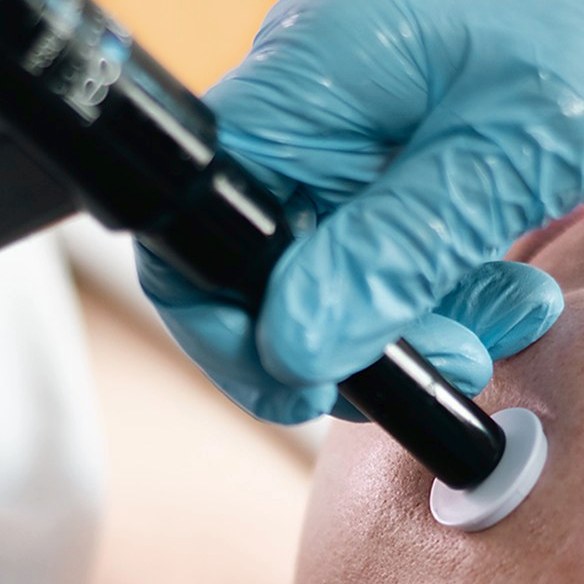
Microneedling works by doing something that sounds backwards: creating controlled micro-injuries in the skin to trigger the body’s own repair response. The healing that follows — new collagen and elastin, faster cellular turnover, tissue remodeling — is what produces the change in texture, tone, fine lines, pore size and scarring, without the downtime or the cost of laser, and without anything being injected.
At The Zen Point, Dana Scarton performs motorized microneedling: a device that holds needle depth and speed consistent across the treatment area instead of varying with hand pressure. There is no downtime, and the results build across a series rather than depending on repeat injections to hold.
How microneedling works — the biology of controlled repair
The wound healing cascade
Skin repairs itself in a well-characterized sequence. In the inflammatory phase, triggered within minutes, platelets release growth factors that start the cascade. In the proliferative phase, over days to weeks, fibroblasts migrate to the area and lay down new collagen and elastin. In the remodeling phase, continuing for three to six months afterwards, that new collagen matures and integrates with the existing dermal matrix. The visible improvement in firmness, texture and scarring arrives across that last phase, which is why patience matters more here than with almost any other cosmetic treatment.
What separates a controlled micro-injury from actual skin damage is depth and distribution. The channels are microscopic, they close within hours, and they leave nothing visible on the surface. The repair response they set off, though, is the same one the skin mounts to genuine injury — which is the entire point.
Why Dana uses a motorized device rather than a roller
A hand roller enters and exits the skin at an angle, which tears more at the surface and makes depth control approximate. A motorized device drives the needles straight in at a set depth, with depth and speed adjustable for different areas of the face. That produces a more even result across the treatment area and allows work close to the eyes and lips, and over bone, where a roller is not safe to use.
What microneedling treats
Fine lines and skin laxity
Collagen and elastin production falls steadily from the twenties onward, accelerated by sun, smoking and hormonal change. The fine lines and loss of firmness that follow are the visible edge of that structural decline. Microneedling works at the tissue level by prompting new collagen in the dermis. That is a different kind of result from the volumizing of a filler or the muscle relaxation of a neurotoxin — it develops over the three to six months following a series rather than appearing within a week.
Acne scars and textural irregularities
Atrophic acne scars — the depressed, pitted scars left when inflammatory acne has damaged dermal collagen — respond through the same collagen induction. New collagen fills the scar from below and raises it toward the surrounding surface. Scarring needs a full series, and the improvement carries on developing for months after the last session while the remodeling phase completes.
Pore size and skin texture
As new collagen improves the dermal support underneath, pores appear smaller and the surface evens out. This is usually the first thing patients notice, often within two to four weeks of the first session, well before anything else has changed.
Hyperpigmentation and uneven tone
The dark marks left behind by acne, minor trauma or sun exposure respond to the faster cellular turnover the repair response drives. Dana often pairs this with topicals applied during the treatment, because the microchannels let actives penetrate considerably further than they can through intact skin. Pigmentation generally needs more sessions than texture does, and she will say so at the intake rather than after session three.
Microneedling, Botox, fillers and laser — how to think about the choice
These treat different things through different mechanisms, and the useful question is which problem you actually have.
Botox and other neurotoxins address dynamic wrinkles — the lines produced by repeated muscle movement, mostly forehead, crow’s feet and between the brows — by temporarily relaxing the muscle underneath. Microneedling does nothing for those. It works on static lines and textural change caused by collagen and elastin loss. The two address different features and are often used alongside each other.
Fillers restore volume, replacing the fat loss that hollows the cheeks, temples and under-eyes. Microneedling does not restore volume. If volume is your main concern, this is the wrong appointment and Dana will tell you so.
Laser resurfacing produces more change in a single treatment, particularly for heavy sun damage and deep wrinkles. The trade is real downtime, a higher risk of pigmentation change in deeper skin tones, and substantially more cost. Microneedling takes a series and gives you no downtime, is safe across all Fitzpatrick types, and costs less per session. Which of those trades suits you is a personal call rather than a clinical one.
Why Dana takes so few of these
Dana caps microneedling at one or two patients a week. It is performed by a licensed acupuncturist who has spent a full ninety-minute appointment reading your skin beforehand, and who puts needles into skin for a living either way. Every session is assessed and adjusted individually rather than run off a standard protocol.
That limit is the reason the schedule for it is thin. If the date you want is not there, email her rather than assuming it is full.
What to expect — before, during and after
The intake session
The first booking is a 90-minute intake at $125, and no needling happens at it. Dana looks at your skin, asks what you have used on it, what has irritated it, and what you actually want changed — then works out the needle depth, the protocol and what is realistic for your skin specifically. Active acne, certain skin conditions, and recent retinoid or isotretinoin use all change the plan. You leave with that plan and a price, and you book the treatment separately.
The treatment session
At the treatment visit, numbing cream or a CBD topical goes on and stays for 15 to 20 minutes. The microneedling itself runs about 20 to 25 minutes. Dana uses a motorized device rather than a hand roller, which keeps needle depth and speed consistent across an area instead of varying with hand pressure.
The needling is one part of a longer appointment. The rest is cleansers, serums, hot towels, a gua sha facial massage, tuning fork vibrations on points along the limbs, and fifteen minutes under the Celluma near-infrared panel to finish.
You will be pink afterwards, closer to mild sun exposure than to anything dramatic. That settles over about 12 to 24 hours, and most people are back in makeup the following day.
The series and the timeline
Skin remodeling is slow. Patients generally notice the first changes — radiance, pore appearance — somewhere around two to four weeks in, and the fuller collagen response develops over three to six months. Dana plans three to six treatments spaced four to six weeks apart, and more than that for hyperpigmentation or acne. After the series, most people come back every four to six months to hold it.
Microneedling is a texture and tone treatment. It will not do what a filler does, and it will not lift anything. If that is what you are after, say so at the intake and Dana will tell you plainly that this is the wrong appointment.
Who should not book this
Tell Dana at the intake if any of the following apply, because some of them rule the treatment out and others simply change the timing:
- Active acne, an active skin infection, or an open lesion in the area.
- Isotretinoin (Accutane) now or recently. Topical retinoids are usually paused beforehand.
- A history of keloid or hypertrophic scarring.
- Pregnancy or breastfeeding.
- A bleeding disorder, or anticoagulant medication.
- Recent sunburn, or a course of laser or chemical peels in the same area.
If you are not sure whether something on that list applies to you, email before you book and Dana will tell you whether to come in.
Common questions about microneedling at The Zen Point
Is microneedling safe for darker skin tones?
Yes. It is one of the few effective resurfacing options that is safe across all Fitzpatrick types, including the deeper tones that carry a higher risk of post-inflammatory hyperpigmentation with laser and chemical peels. Because there is no thermal injury and no chemical disruption of the epidermis, that risk is considerably lower here. If you have been advised against laser resurfacing for that reason, you are generally a good candidate for this. Dana confirms the protocol against your skin type and history at the intake.
How is this different from booking it at a med spa?
The differences are the intake and the volume. You get a full ninety minutes of assessment before anything is needled, and Dana takes one or two microneedling patients a week rather than running it as a throughput service. Depth, pass count and topicals are set against your skin rather than against a house protocol. Whether that is worth it to you depends on how well standard treatment has worked on your skin so far.
Booking
Everyone starts with the microneedling intake. It is a separate appointment type from a standard acupuncture visit, so choose it specifically when you book.
Book the microneedling intake →
I have just completed my third deluxe micro-needling treatment for my face and neck. My skin is noticeably smoother, with smaller pores, lighter age spots, and less prominent wrinkles. She is thorough in her explanation of everything that she does during the treatment and welcomes any questions that I have.